 Sikh Journey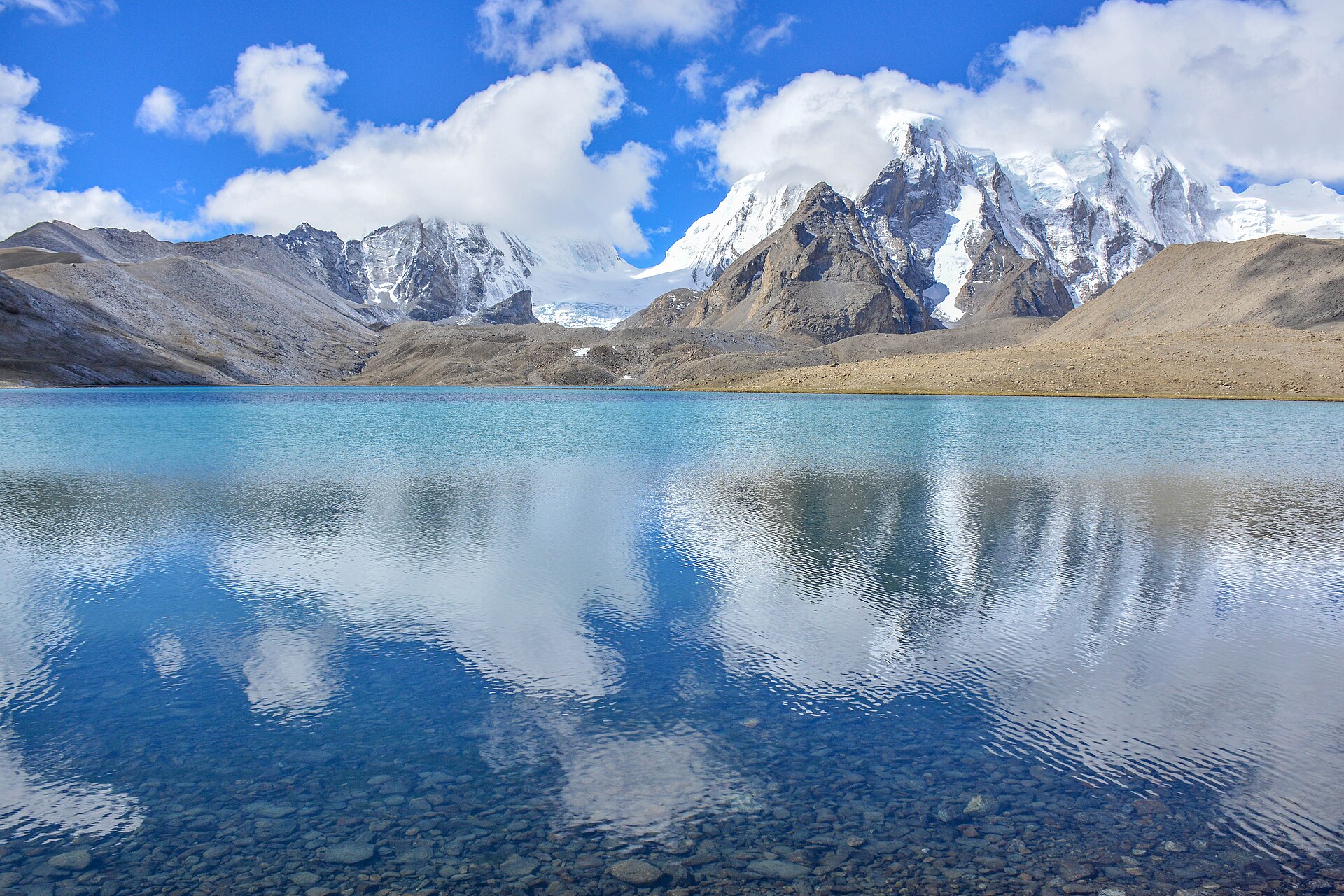
Trip guide · 7 min read
Sikkim: The Highest Gurdwara in the World, and What Else to Know
Guru Nanak Dev's third Udasi reached further than most people realize — all the way to a lake in far North Sikkim. Here's the history, what to see and eat, and an honest word on the altitude.
History worth knowing
Sikkim's Sikh heritage isn't a footnote — it's one of the more remarkable stretches of Guru Nanak Dev's third Udasi, the same journey north that our Kashmir itinerary also touches, just a very long way further along. According to Sikh tradition, after passing through Tibet, Guru Nanak entered Sikkim through the Chhorten Nyi-ma La pass, moving through Dolma Sampa and Tongpen into the Muguthang valley, visiting a string of small settlements before reaching the high plateau around what is now Guru Dongmar Lake. One account holds that the purpose of this leg wasn't just travel for its own sake — he is said to have gone to offer support to Karma-pa Nying-ma-pa Buddhist communities then being pushed out of Tibet by the rival Ge-lug-pa sect, and some of their head lamas reportedly became his followers after long discussions near Kailash Mansarovar.
Gurdwara Nanaklama Sahib, in the North Sikkim town of Chungthang, marks this route in the most concrete way. It was built in 1969 by the Assam Rifles, with help from the local MLA at the time, Tasa Tangey Lepcha — a small, unhurried gurdwara that most visitors reach on the drive between Gangtok and Lachen, rather than as a dedicated pilgrimage stop.
Guru Dongmar Lake itself carries the more striking story. At around 17,800 feet, it's one of the highest lakes in the world, and Sikh tradition holds that part of it used to freeze solid every winter until Guru Nanak, passing through, touched the water and left a section permanently unfrozen so nearby communities would always have something to drink. A small gurdwara built on the shore, Gurdwara Sri Guru Dongmar Sahib, is widely described as the highest gurdwara anywhere — a claim that's hard to verify precisely, but not hard to believe once you're standing there. Some accounts also describe relics — a robe, footprints, and a water vessel (kamandal) — preserved at Lachen Gompha nearby as further evidence of the visit.
The other Sikh story in this region belongs to a much more recent chapter. Harbhajan Singh, a Sikh soldier with the 23rd Punjab Regiment, died in 1968 near Nathula while escorting a mule column, apparently after slipping into a glacial stream. According to the story soldiers still tell, he appeared afterward in a colleague's dreams, describing where his body could be found and asking that a memorial be built. That shrine, Baba Harbhajan Singh Mandir, still stands near Nathula today, and soldiers posted along this stretch of the border — by some accounts, including Chinese soldiers on the other side — treat him as a protector spirit watching over the pass.
What to see
Rumtek Monastery, about 24 km from Gangtok, is the largest in Sikkim and became the seat-in-exile of the Karmapa, head of the Karma Kagyu school of Tibetan Buddhism, after the Chinese takeover of Tibet. It's a living monastery rather than a museum piece — young monks are often visible going about ordinary routines between the more elaborate prayer halls.
Nathula Pass itself, at over 14,000 feet on the India-China border, is one of the few Himalayan border crossings tourists can actually visit — and one with real history behind it: this was once a stretch of the old Silk Route, with mule trains carrying silk, wool, and other goods between India and Tibet until the pass was sealed after the 1962 war. It reopened for limited, seasonal border trade in 2006, and Chinese soldiers are often visible on the other side of the marker.
Tsomgo Lake changes character completely with the seasons — a clear blue-green through spring and autumn, and frozen over in winter. And Gurudongmar Lake, once you're actually there, is less a lake to look at than a landscape to take in: turquoise water against bare, snow-dusted peaks, with almost nothing else in view.
What to do
This trip is built around slow, deliberate movement rather than activity for its own sake — a walk through Rumtek's courtyards, time spent quietly at Tsomgo Lake's edge, a look across the fence at Nathula. At altitude, that unhurried pace isn't just pleasant, it's genuinely the right way to move: go slowly, drink more water than feels necessary, and treat any stop above 12,000 feet as a place to rest rather than push through.
Gurudongmar Lake is the one day on this itinerary that asks the most of you, and it's worth repeating here: it's an early-morning excursion to real, serious altitude, and the right response to feeling unwell on the day is to turn back, not push on. Everywhere else on this trip moves at a much gentler pace.
What to eat
Sikkimese food draws on three communities — Lepcha, Bhutia, and Nepali — and the results show up on almost every menu. Momos (steamed or fried dumplings) and thukpa (a noodle soup built on a ginger-garlic-onion broth) are the two dishes visitors recognise fastest, but they're really just the entry point. Gundruk, a fermented leafy-green dish of Nepali origin, and chhurpi, a yak-milk cheese that comes both soft (closer to paneer) and hard (grated over food or nibbled slowly like a candy), are both worth trying if you see them on a menu.
Look out too for sel roti, a ring-shaped, slightly sweet rice-flour bread often served around festivals, and for two ingredients that shape the whole region's flavour profile: timur (Sikkim pepper), which has a citrusy, faintly numbing quality, and dalle khursani, a small, extremely hot round chilli grown locally. It's also worth knowing that Sikkim is India's first fully organic state — farming here has been pesticide-free by law since 2016, so the vegetables on your plate are very likely grown within the state itself.
Trivia & local lore
Soldiers stationed near Nathula tell a specific, oddly touching version of the Harbhajan Singh story: that his belongings are still packed up and sent home on an annual leave, with a berth kept for him on the train, and that duty rosters and pay accounts have historically listed him as an active, serving soldier. How literally any of that is still practiced varies by account, but the tradition itself has held for decades.
Before 1962, roughly 200 mules a day carried goods between Gangtok and Lhasa via Nathula, a journey that took 20 to 25 days one way — a genuinely significant trade route, not just a mountain footpath, until the war closed it for 44 years.
And Gurudongmar Lake's "highest gurdwara in the world" reputation is one of those claims that's repeated more often than it's formally verified — but at 17,800 feet, in a region with very few other structures at that altitude at all, it's not a hard one to accept at face value.