 Sikh Journey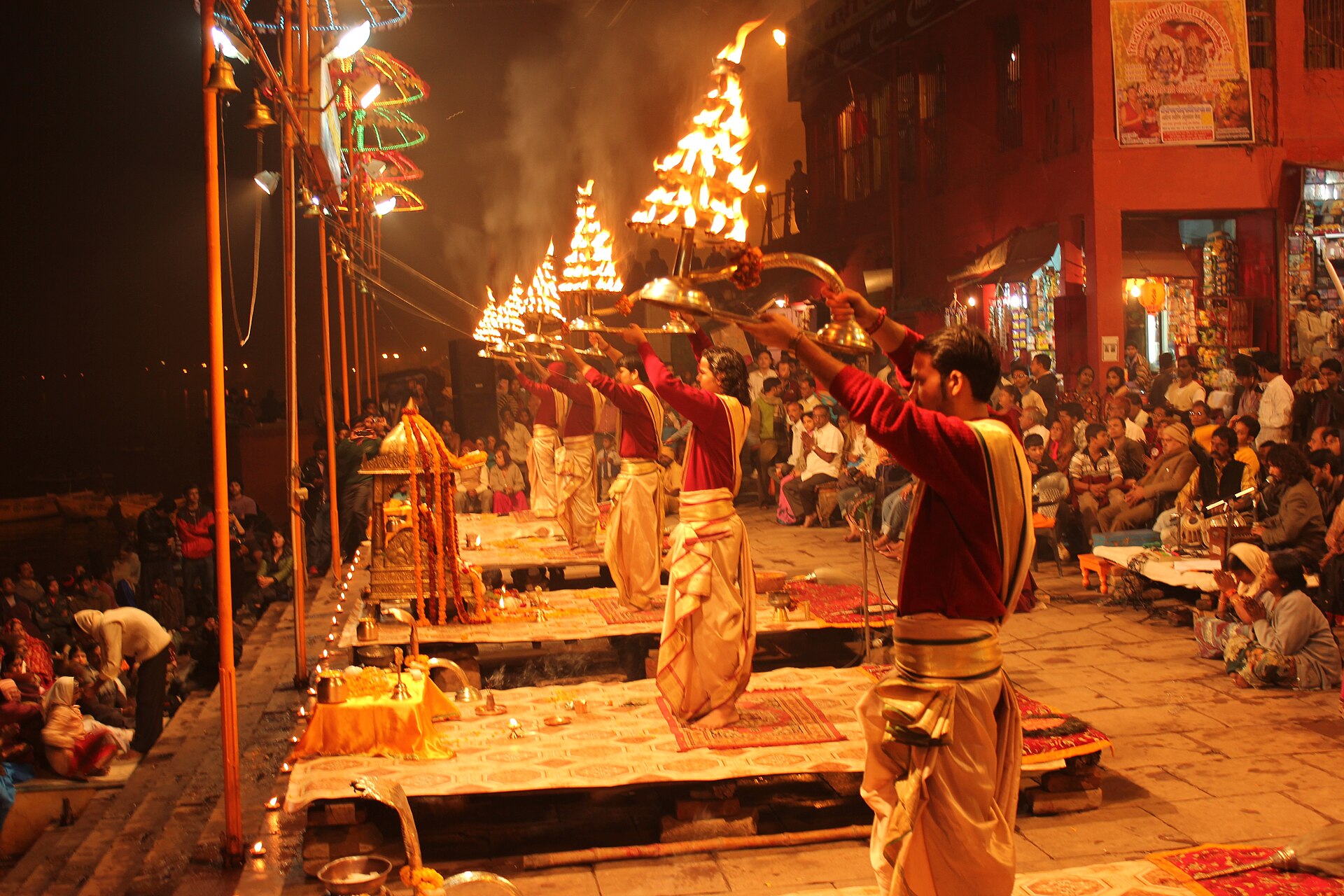
Trip guide · 7 min read
Varanasi and Ayodhya: History, Food, and What to See
A closer look at two of North India's oldest cities — where Guru Nanak Dev held court with Varanasi's scholars, why a Sikh Maharaja gilded a Shiva temple, and what to actually eat while you're there.
A city older than memory
Varanasi's exact age is genuinely disputed, but the disputes are all about just how old, not whether it's old. Archaeological digs at Rajghat, on the riverbank, have turned up pottery and settlement evidence going back roughly 3,000 years, with some radiocarbon studies pushing continuous habitation back even further. It's routinely named alongside Damascus and Jericho as one of the oldest continuously inhabited places on earth, and it shows up by name in the Rig Veda and the Mahabharata. None of that is why people visit today, but it's worth knowing as you walk the ghats — you're not looking at a restored old town, you're looking at a city that's been doing this the whole time.
Kashi Vishwanath Temple, the Shiva shrine at the centre of it all, has its own long and interrupted history — the temple has been destroyed and rebuilt more than once over the centuries, and the structure standing today was built in 1780 by Queen Ahilyabai Holkar of Indore. In 1835, Maharaja Ranjit Singh, the Sikh Empire's founder, donated roughly a tonne of gold to plate its domes and spire, which is why the temple is still sometimes called the Golden Temple of Varanasi — a slightly confusing name if you've also been to Amritsar. It's one of a handful of places where Ranjit Singh's patronage crossed religious lines; he also funded work at other Hindu shrines despite ruling as a Sikh monarch. More recently, the Kashi Vishwanath Corridor — a wide pedestrian route linking the temple directly to the Ganga — opened in December 2021, cutting what used to be a cramped, winding walk down to a few minutes.
Where Sikh history meets the rivers
Guru Nanak Dev's own connection to Varanasi dates to around 1507, during the first of his four great journeys. Tradition holds he arrived on Shivratri and stopped to rest in a garden that came to be known as Guru Ka Bagh, where he fell into conversation with a group of Brahmin scholars. One of them, Pandit Chatur Das, is said to have pressed him on why he carried none of the usual markers of religious learning — no rosary, no sacred thread, no mark on his forehead. Guru Nanak's answer, roughly, was that none of that mattered next to remembering God and serving others — and Chatur Das is said to have become a follower on the spot. The garden itself is long gone, but a white marble sanctum was built on the site in 1969 for Guru Nanak's 500th birth anniversary, and that's the gurdwara you'll visit today.
Ayodhya's Sikh connection is less well known but, if anything, more concentrated: three separate memorials sit within about 50 metres of each other by Brahma Kund, on the banks of the Saryu. According to Sikh tradition, Guru Nanak Dev visited around 1510-11, Guru Tegh Bahadur (the ninth Guru) in 1668, and Guru Gobind Singh (the tenth) as a child in 1672 with his father. Guru Nanak's memorial is the simplest of the three — just a Nishan Sahib flag on a platform built in 1972. Guru Tegh Bahadur's site stayed a bare platform until 1975, when Sikh soldiers stationed at the nearby Faizabad Cantonment built a small room over it. The most substantial of the three, Gurdwara Guru Gobind Singh Ji, was built in 1899 by a Kashmiri Sikh named Gulab Singh, and today holds relics including sandals said to have belonged to Guru Tegh Bahadur.
What to see
Beyond the ghats themselves — and there are around 80 of them strung along the river — the two standout sights are Sarnath and Ayodhya's Ram Mandir. Sarnath, about 13 km from Varanasi, is where the Buddha is traditionally believed to have delivered his first sermon after attaining enlightenment. The centrepiece is the Dhamek Stupa, a 34-metre brick-and-stone drum originally built around 249 BCE under Emperor Ashoka, with carved bands from the Gupta period (4th-6th century CE) layered onto the older core. It's a quiet, park-like site that makes an interesting contrast to Varanasi's crowded riverfront.
In Ayodhya, the new Ram Mandir — consecrated in January 2024 on a site regarded as Ram's birthplace — is now the city's biggest draw, and Hanuman Garhi, a hilltop shrine to Hanuman reached by a 76-step climb, is considered a customary stop before it. Hanuman Garhi's own founding is genuinely contested between several centuries-old legends, which is part of its charm rather than a problem to resolve.
What to do
Most of what's worth doing in Varanasi happens on or beside the water. A sunrise boat ride along the ghats, when the light is flat and gold and the crowds haven't arrived yet, is the closest thing the city has to a signature activity — you don't need to do anything except sit and watch the city wake up. In the evening, the Ganga Aarti at Dashashwamedh Ghat is the reverse: a loud, choreographed ritual of fire, bells, and chanting performed for a packed audience, best watched either from the ghat's steps or from a boat idling just offshore. Between the two, a slow walk through the old city's lanes near Vishwanath Gali is worth the time it takes to get a little lost.
What to eat
Varanasi takes its food as seriously as its rituals. Kachori-sabzi — deep-fried, spiced kachoris served with a tangy vegetable curry — is the standard breakfast, usually eaten standing at a counter rather than sitting down. Tamatar chaat, a tomato-based chaat that's more or less unique to the city, is worth seeking out if you see it. Thandai, a chilled, nut-and-spice milk drink, is sold everywhere and gets a stronger, festival version around Shivratri and Holi. Lassi here is thick enough to eat with a spoon, usually served in a clay kulhad and topped with a layer of malai (cream) — it's a genuinely different drink from the lassi you'll find elsewhere in India. And Banarasi paan, a betel-leaf preparation eaten after meals, is as much a small ceremony as it is a snack; it's referenced often enough in Hindi cinema that you'll probably recognise it even on a first visit.
If you want to bring something home, look for a genuine Banarasi silk saree — Varanasi has been a weaving city for roughly 3,000 years, and its brocades, woven through with gold and silver zari thread, reached their best-known form under Mughal patronage from the 16th century onward. The name is now protected by a Geographical Indication tag, so a saree woven elsewhere can't legally be sold as Banarasi.
Trivia & local lore
A few things worth knowing before you go: Varanasi has at least five names across its history — Kashi, Banaras, Varanasi, and a couple of older Puranic names among them — and locals use them fairly interchangeably. The Kashi Vishwanath Temple's gold covers roughly 800 kg of surface area across its domes and spire, most of it still traceable to Ranjit Singh's original 1835 donation, though a further 60 kg was added by an anonymous donor as recently as 2022. And Hanuman Garhi's own origin story has at least three competing versions — a king, his brother, and a 16th-century saint named Tulsidas all get credited in different tellings, and no one account has definitively won out.